
This explanation comes from GEOMAC, the manufacturer of the soil-decompaction machine. We design, develop and build the machine in our own workshop in Ederveen, the Netherlands, and run it in the field ourselves. We do not offer soil decompaction as a service: professionals carry out that work themselves, with our machine.
Arborist, landscaper, green-space contractor or municipal department: with your own machine you schedule the work whenever it suits you.
View the machine →Then you have come to the wrong place: we supply machines, not site work. Look for an arborist or landscaper in your region who offers soil aeration. If you need it regularly, owning a machine soon pays for itself.
How does soil decompaction work?
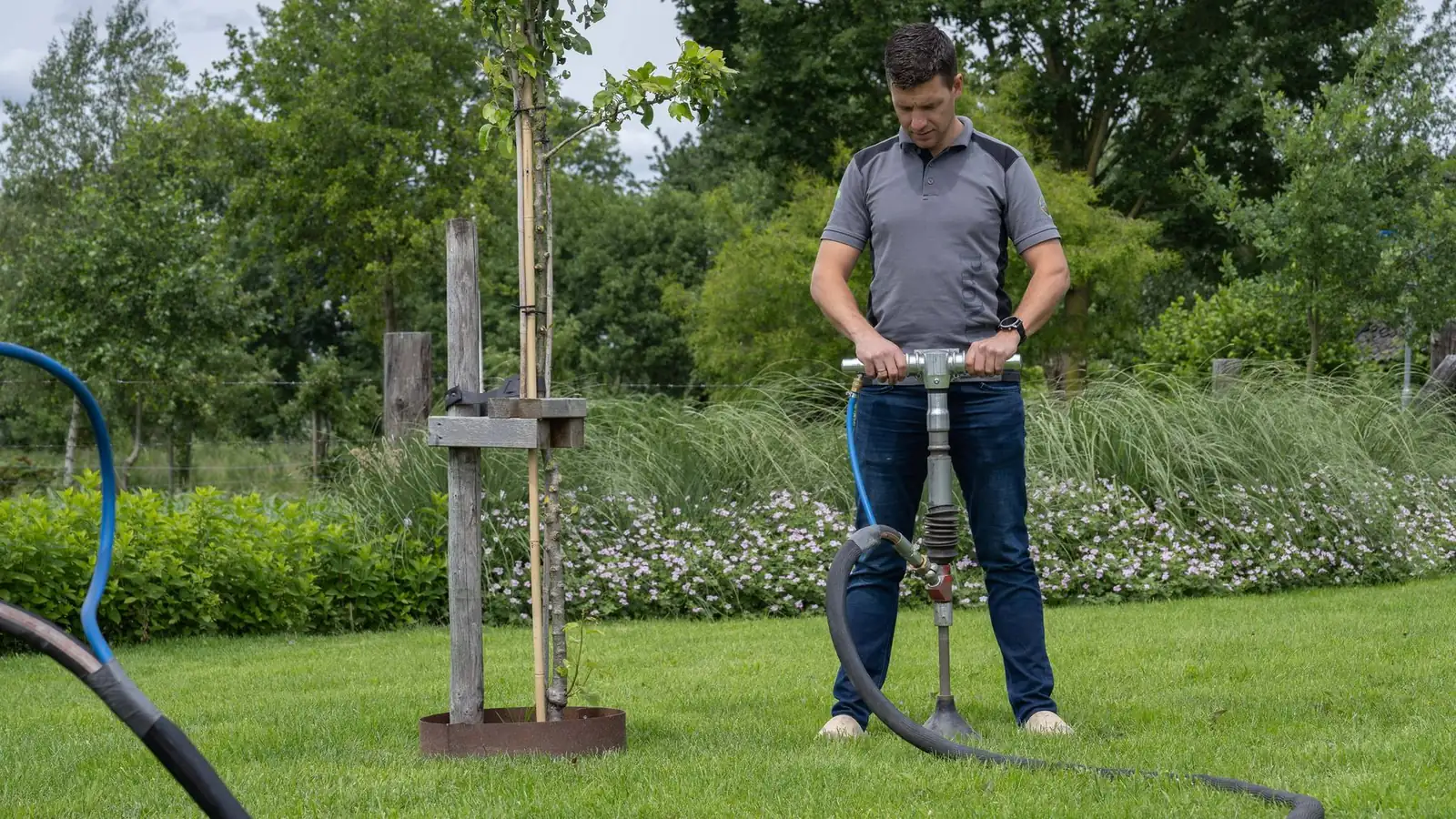
Soil decompaction happens in four steps. A hollow lance is inserted into the ground and, at depth, delivers a short, powerful burst of air that breaks the compacted layer open: the air follows the path of least resistance and creates fracture planes right through the layers. Prefer to watch rather than read? Watch the animation on the video page.
The hollow lance goes into the ground to about 60 cm, at the desired working depth.
A short burst of compressed air at 6 to 8 bar breaks the compacted layer open.
Cracks and channels form; soil life and roots get oxygen again.
Via the material tank, soil improvers or nutrients go straight into the freshly made fractures.
Breaking open is half the work
The burst makes the route. What travels along it decides what happens next: air alone gives a temporary result, while soil life only gets going once food arrives with it. That is a story of its own, and it lives on the page about soil injection: what the lance can and cannot carry, how much goes in per insertion, and why that volume tells you something about the soil.
Beyond that, the result stands or falls with a skilled operator and with removing the cause of the compaction, continuing load or foot traffic for instance. That skill lies mostly in knowing the soil: how wet the ground is at that moment already decides much of what a burst will do. If the cause cannot be removed, repeating the treatment periodically keeps the soil in condition.
When to decompact soil (and when not)?
Soil decompaction is ideal for compacted, oxygen-poor soils and for trees in decline. It can also be worthwhile in soil that is fine in itself: the same fracture lines let you bring in material where it is needed, such as a nutrient this particular tree is missing. In a few situations, caution is needed.
- Compacted or rutted soil
- Wet spots and pooling water
- Trees in decline or growing poorly
- Root-zone improvement for existing trees
- After construction work or heavy traffic
- Cables and pipes: locate them first (utility check)
- Very wet clay can react differently
- Repeated loading: compaction can return
- Right alongside paving or foundations
What does soil decompaction cost?
There is no fixed price for soil decompaction: the cost depends on the number of trees or the area, the degree of compaction, how accessible the site is and whether nutrients are injected too. And on the operator, of course: that expertise is part of the rate. If you do this work regularly, owning a machine soon works out cheaper than repeatedly hiring or outsourcing. How many trees or square metres you cover in a day cannot be pinned to a single figure for the same reason: the soil, the situation and the operator’s experience set the pace. What we do control is the machine. We are out in the field with it ourselves, and anything that can be faster, sturdier or easier to control goes back to the workshop and returns improved. The compressor determines the result as well: the more air it delivers, the more effectively the burst breaks open the compacted layer.
GEOMAC does not carry out soil decompaction as a service; we develop and sell the machine that professionals use to do it themselves.
Decompact soil yourself or outsource?
If you regularly work on compacted soils or root-zone improvement (as an arborist, landscaper or green-space contractor), owning a machine soon pays for itself. The GEOMAC soil-decompaction machine is compact, fully electric and built in the Netherlands, with a 40-litre buffer tank and adjustable dosing. That way you decompact the soil yourself, whenever it suits you, ideally to relieve soil compaction. Compacted soil is the rule rather than the exception in the Netherlands, and with the weather of recent years, long dry spells alternating with heavy downpours, it is showing more and more.
Frequently asked questions about soil decompaction
Does soil decompaction damage a tree’s roots?
No. The air follows the natural weak points in the soil and pushes soil particles apart instead of cutting through roots. The root system stays intact and actually gains more air and space.
How deep does soil decompaction go?
Usually to about 60 cm deep. That already covers most problems: by far the most soil life sits in that top layer, and so does the restrictive, compacted layer holding back the roots. If more depth is needed, the lance can be made to measure.
How often do you need to decompact the soil?
The point of a treatment is to get the soil life going again; that is what makes the result last. How often that is needed varies from one situation to the next. Repeating it often helps, because each pass brings air and nutrients down to depth again. Where the load persists or the situation is extreme, repeating makes more sense. In practice decompaction rarely stands on its own but belongs to a set of measures; which of those fit is judged by the specialist.
What is the difference with soil aeration?
Soil decompaction is a form of soil aeration using compressed air: it breaks open specific, compacted layers deeper and wider in the soil. Surface aeration mainly works in the top layer.
What is the difference with air spading?
Air spading (with an Air-Spade) blows soil away with a supersonic air jet to expose roots or utilities: an excavation technique that removes the soil. Soil decompaction leaves the soil in place: a hollow lance injects a burst of compressed air at depth, fracturing the compacted layer from within. The two are often confused, but they solve different problems.
Why is air volume (flow) important for soil decompaction?
Do not look at pressure alone: high flow matters just as much. Pressure supplies the breaking force, but the moment the layer opens, air escapes. With too little flow (air volume per minute) the pressure drops away at once; with enough, the pressure spreads further through the soil and the burst is more effective. The high air velocity this creates carries injected material further into the fractures, so you are left with as few plugs or nests of material as possible.
In practice you will also see it called decompacting soil or pneumatic soil decompaction, and the machine a soil-decompaction machine. In Dutch the work is known as grondploffen or bodemploffen.
Ready to start soil decompaction?
View the GEOMAC soil-decompaction machine, or ask for pricing or an on-site demonstration. We supply the machine; you carry out the work yourself.