
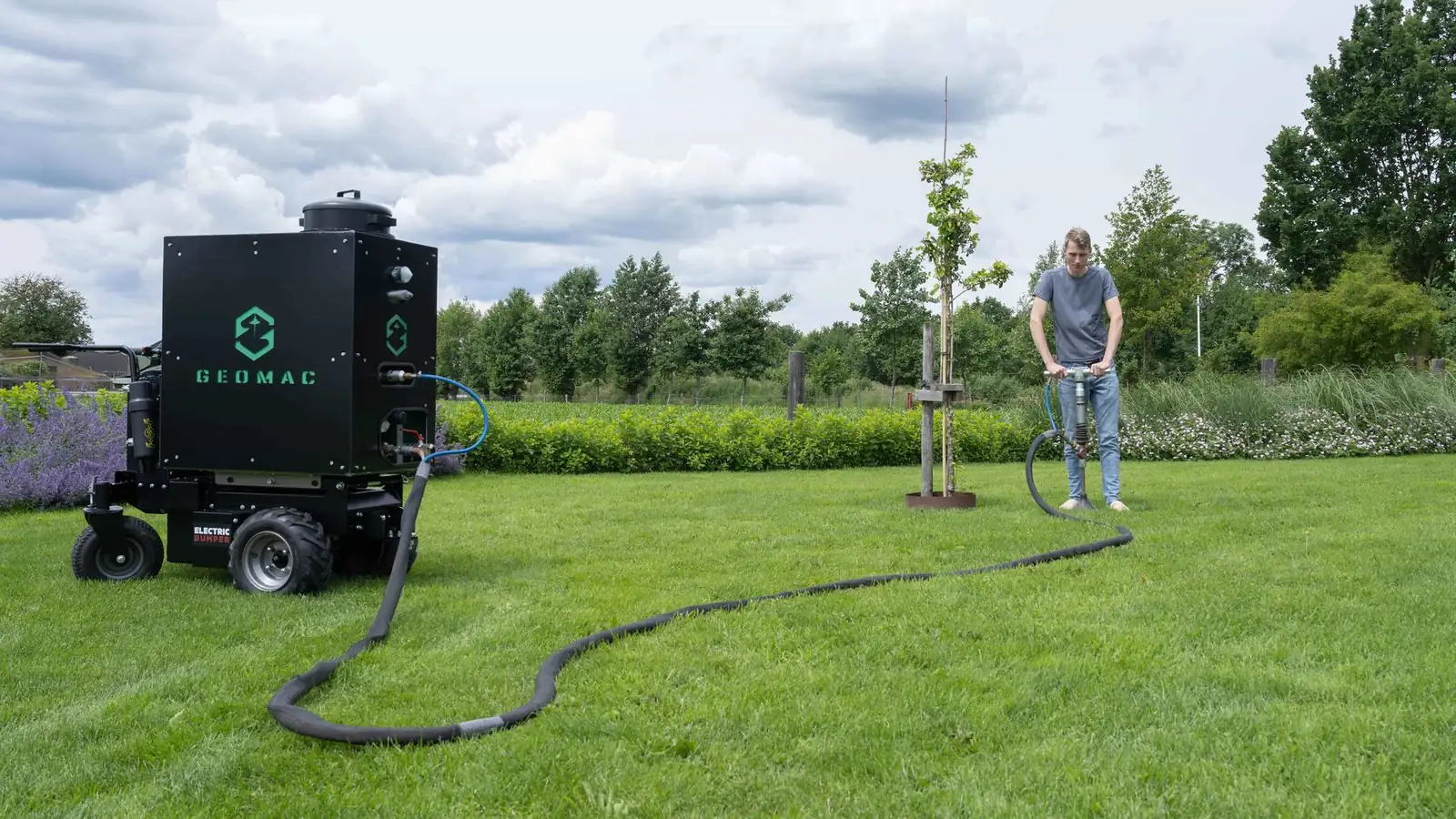
This explanation comes from GEOMAC, the manufacturer of the soil-decompaction machine. We design, develop and build the machine in our own workshop in Ederveen, the Netherlands, and run it in the field ourselves. We do not offer soil aeration as a service: professionals carry out that work themselves, with our machine.
Arborist, landscaper, green-space contractor or municipal department: with your own machine you decide when you work and how deep you go.
View the machine →Then we are the wrong address: we supply machines, not site work. Look for an arborist or landscaper in your region who offers soil aeration. If you need it regularly, owning a machine soon pays for itself.
Lawn aeration is not the same as soil aeration
The difference is depth, and therefore which problem you actually solve. If your restrictive layer sits at 40 cm, a lawn aerator working the top layer will not help you.
Spiking or hollow-tining the top 5 to 10 cm, usually to break through thatch and help grass root better. Work for a lawn aerator or a deep-tine unit.
- Depth: a few centimetres
- Target: the sward and the top layer
- Never reaches a tree's root zone
Air delivered at the depth where the restrictive layer sits, usually as compressed air through a hollow lance. This is the work that trees and planting actually benefit from.
- Depth: to about 60 cm, deeper if needed
- Target: the compacted layer and the root zone
- Nutrients can go straight into the soil
Which soil-aeration methods are there?
There are broadly three ways to get air into soil. They differ in depth, in how much they disturb the soil, and in whether you can inject anything alongside.
Tines or hollow tubes making holes. Fast and cheap, but shallow, and it can compact the wall of the hole further.
Removing the compacted soil and replacing it with tree substrate. Thorough, but expensive, invasive and rarely possible around an existing tree.
A burst of air at depth fractures the layer from within. The soil stays put, roots stay intact, and nutrients can go along. This is soil decompaction.
Which method fits depends on the depth of the restrictive layer and on what is growing above it. Around an existing tree, excavation is almost always out: you would cut through the very root system you are trying to save. That leaves aerating with compressed air.
When is soil aeration needed?
Soil aeration comes into play as soon as air and water no longer reach the root zone. The signs are usually above ground, well before anyone digs a hole to look.
- Water standing for a long time
- Trees setting back or colouring early
- After construction traffic over the root plate
- When planting into a tight tree pit
- Foot traffic: paths, events, parking on grass
- How deep does the restrictive layer sit?
- How wet is the ground right now?
- Are there cables and pipes below?
- Will the cause of the compaction remain?
Moisture content largely determines what a burst of air does. That is why the result stands or falls with the operator's knowledge.
Frequently asked questions about soil aeration
What is the difference between soil aeration and soil decompaction?
Soil aeration is the collective term for every way of getting air into the soil, from a spiked roller to an air lance. Soil decompaction is one specific method within it: aerating with short, powerful bursts of compressed air through a hollow lance, at depth. So all soil decompaction is soil aeration, but not all soil aeration is soil decompaction.
How often should soil be aerated?
That depends on the load and on the situation. If the cause of the compaction is removed, soil life can take over the recovery. If the load continues, through foot traffic or vehicles for instance, repeating it periodically makes sense.
What is the best season for soil aeration?
It can be done all year round, as long as the ground is neither frozen nor saturated. Moisture content matters more than the calendar: air travels differently through sodden clay than through soil at field capacity. If you are injecting nutrients or soil improvers, the growing season is the logical choice, because the tree can use them straight away.
Do you need a compressor for soil aeration?
For aeration with compressed air, yes. The compressor supplies the air volume that keeps the pressure up once the layer opens, and so determines how far the burst reaches; the machine doses it and brings it in. For the GEOMAC a compressor delivering at least 4,500 l/min at 8 bar is recommended. Mechanical spiking works without a compressor, but it does not reach depth.
Aerating soil yourself?
View the GEOMAC soil-decompaction machine, or ask for pricing or an on-site demonstration. We supply the machine; you carry out the work yourself.