
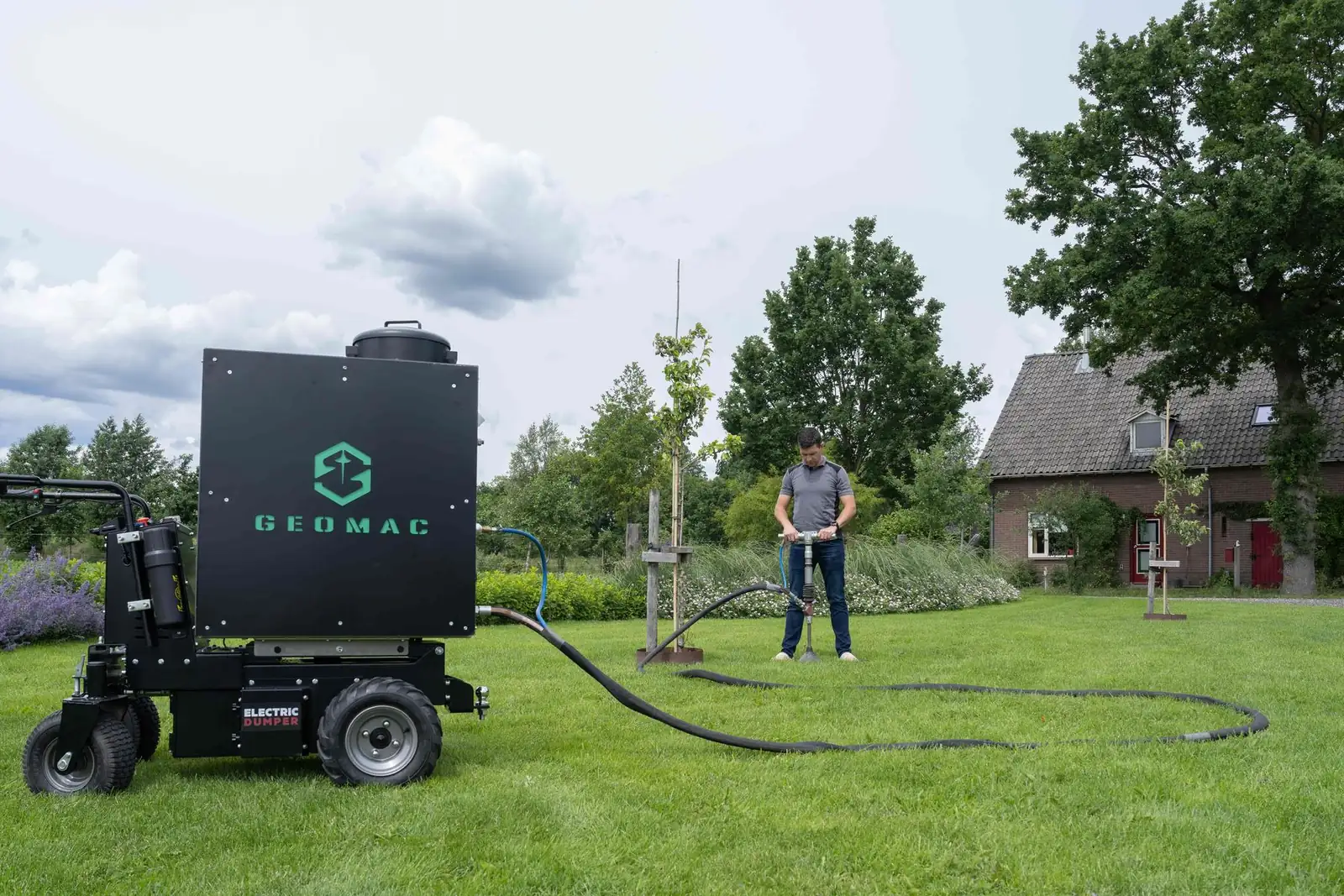
This explanation comes from GEOMAC, the manufacturer of the soil-decompaction machine. We design, develop and build the machine in our own workshop in Ederveen, the Netherlands, and run it in the field ourselves. We do not offer compaction relief as a service: professionals carry out that work themselves, with our machine.
Arborist, landscaper, green-space contractor or municipal department: with your own machine you tackle compacted spots as you come across them.
View the machine →Then you have come to the wrong place: we supply machines, not site work. Look for an arborist or landscaper in your region who offers soil aeration. If you need it regularly, owning a machine soon pays for itself.
How do you recognise soil compaction?
You recognise soil compaction by waterlogging, disappointing growth and a hard layer below the surface. Often you see several signs at once.
- Pooling; water stands for a long time
- Lagging, struggling growth
- Trees dying back or discolouring early
- Bare patches in lawn or verge
- A hard layer just below the surface
- Roots grow horizontally instead of going deep
- Grey, oxygen-poor or musty soil
- Soil that is heavy and hard to dig
What causes soil compaction?
Soil compaction mainly arises from pressure and loading that squeeze the pores in the ground together. With those pores goes the space for water to drain away and air to move in: in wet spells the water stands on top of the compacted layer and the ground turns short of oxygen, in dry spells the roots cannot reach the moisture sitting below it. Little oxygen and ground that is alternately too wet and too hard is poor going for soil life, while it is worms and roots that make the channels the structure would recover through. That is how a compacted layer keeps itself in place: recovering on its own takes years, and deeper down far longer still.
Machines, trucks and repeated driving over the same spot.
Storage, trackway mats and earthmoving around trees and gardens.
Many pedestrians, events or livestock on a small area.
Wet soil is extra sensitive and compacts faster under pressure.
How do you relieve soil compaction?
The most targeted method is soil decompaction: with a hollow lance, compressed air at 6 to 8 bar is injected into the ground to about 60 cm, where the compacted layer breaks open along the path of least resistance. Cracks and channels form so air, water and roots can reach deep into the soil again. In straightforward situations, a back garden where everything is in place except a healthy soil, that is often enough to break the negative cycle: excess water can drain, air returns and the soil life can resume its work. Adding soil stimulants at the same time helps that along. All of this without excavating the ground.
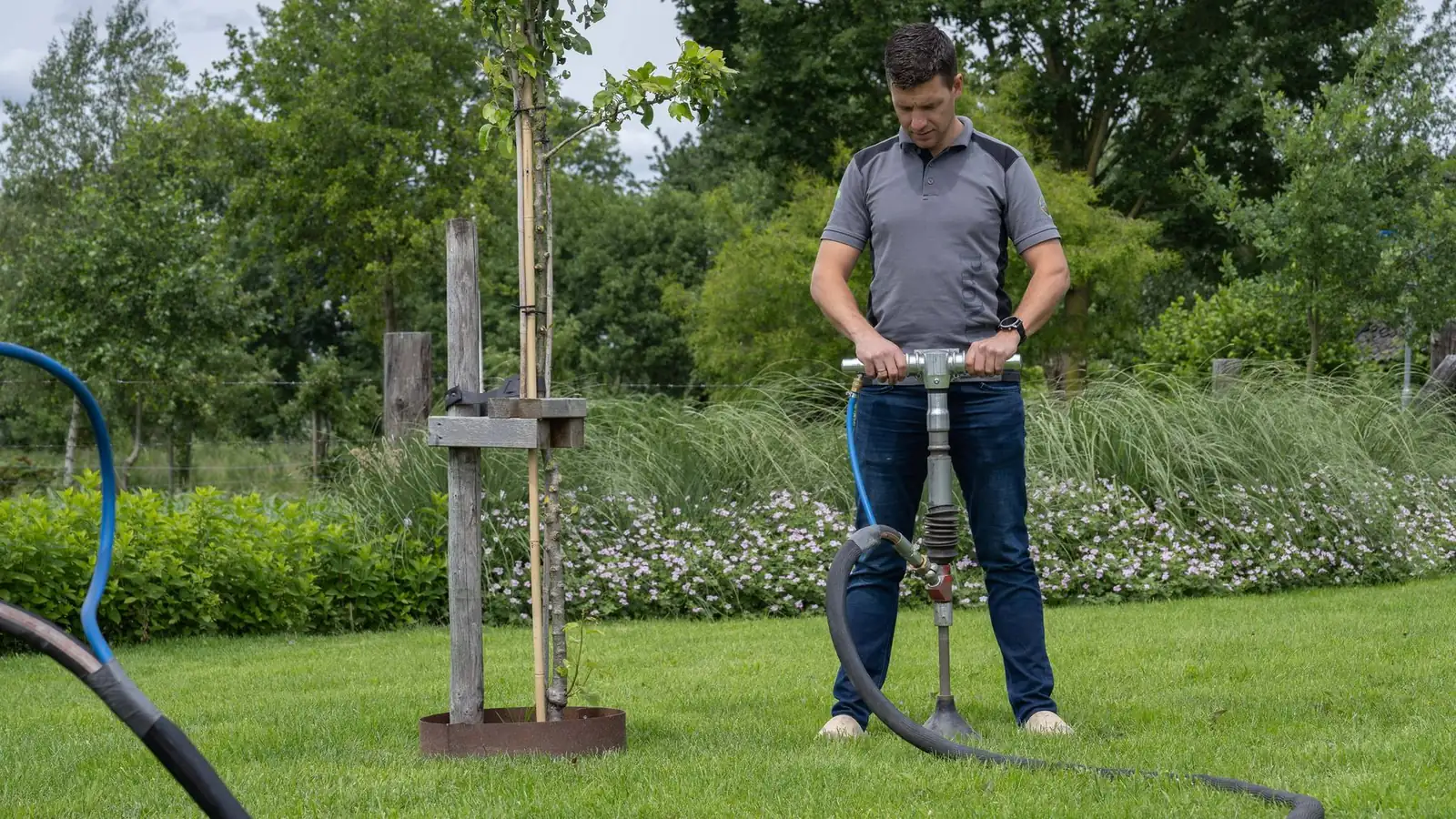
Relieve soil compaction yourself with the GEOMAC
If you regularly work with compacted soils (as an arborist, landscaper, green-space contractor, municipality or contractor), you relieve compaction with your own machine wherever and whenever you want. The GEOMAC soil-decompaction machine is compact, fully electric, has a 40-litre buffer tank with adjustable dosing and is built in the Netherlands. GEOMAC does not carry out the work as a service; we develop and sell the machine that professionals use to do it themselves.
Frequently asked questions about soil compaction
Can you relieve soil compaction without digging or turning the soil?
Yes. With soil decompaction you break open the compacted layer with compressed air from the inside, without digging out the soil. The soil structure and soil life stay largely intact.
How deep does soil compaction sit?
Most compaction sits in the top 60 cm. That layer holds by far the most soil life, which is why decompacting at that depth is the most effective, certainly combined with injecting nutrients and soil improvers.
Does soil compaction come back?
If the soil is loaded again, compaction can return. By limiting the load and restoring soil life, you keep the result for longer.
Tackle soil compaction yourself?
View the GEOMAC soil-decompaction machine, or ask for pricing or an on-site demonstration. We supply the machine; you carry out the work yourself.