
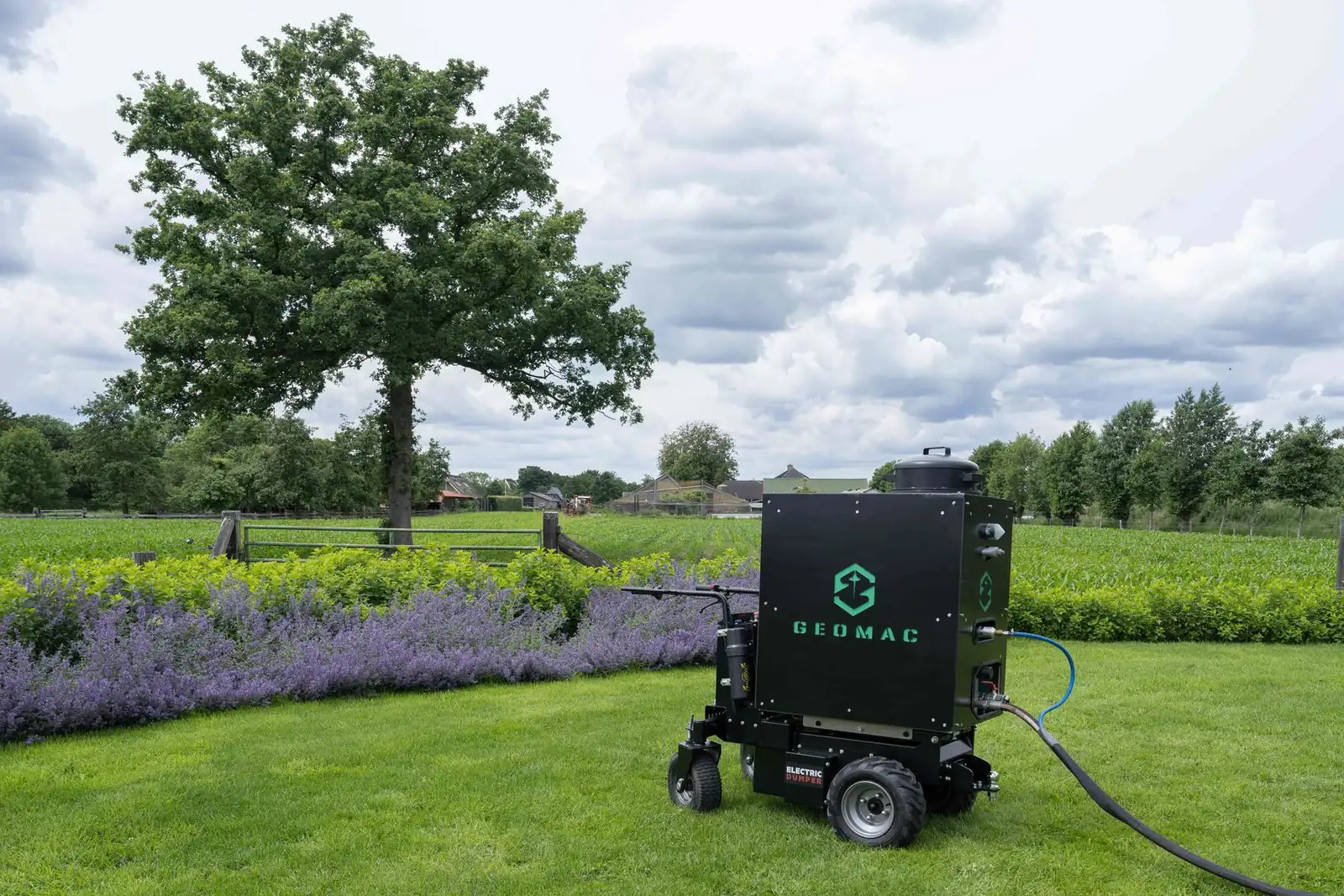
This explanation comes from GEOMAC, the manufacturer of the soil-decompaction machine. We design, develop and build the machine in our own workshop in Ederveen, the Netherlands, and run it in the field ourselves. We do not offer soil injection as a service: professionals carry out that work themselves, with our machine.
Arborist, landscaper, green-space contractor or municipal department: with your own machine you decide what goes into the ground.
View the machine →Then you have come to the wrong place: we supply machines, not site work. Look for an arborist or landscaper in your region who offers soil injection. If you need it regularly, owning a machine soon pays for itself.
The fracture is the delivery channel, not the goal
The burst creates fractures right through the layers. In time they close again, and that is fine. What matters is what ends up along those walls in the meantime: while they are open, there is a route into the root zone that does not otherwise exist.
Material spread on the surface still has to work its way through the same dense layer you have just opened. Material that travels with the burst is there at once.
The material settles on the fracture wall. From there roots and soil life work outwards, into the ground in between.
A lasting effect only appears once soil life takes over. It is the one thing in a soil that maintains and extends itself.
What goes into the ground?
Which product you choose matters less than which function you need. Three of them go through the lance; one does not.
- Holding open — granules that give temporary counter-pressure, perlite for instance
- Feeding — carbon and nutrients for the microflora
- Inoculating — the organisms themselves, where soil life has all but gone
Feeding and inoculating are not the same thing. In a soil with hardly any life left you are feeding something that is not there; then you need both.
- Water retention — that takes mass, cubic metres
A water-holding granule does its work locally along the fracture wall, but storage for the whole site comes from above, from a compost or mulch layer. Anyone promising that injection will build you a moisture-retaining soil is overselling it: far too little material goes in for that.
How much goes in, and what does that tell you?
In Dutch, largely sandy soils around 10 litres per insertion is normal, rising to 30 litres where the soil allows it. In heavy clay and loam it will not. That difference is information in itself: how much material the soil accepts tells you whether a usable fracture network has formed. If the volume will not go anywhere, there is no network to deliver along and carrying on has little point.
You measure it while working, with no extra step. Record it per tree and your job report actually says something.
If air velocity drops, material falls out of the stream near the lance and stays behind in plugs. Enough flow carries it further into the fractures.
At nine to eleven insertions per tree you reach 100 to 300 litres. Against a rootable zone of tens of cubic metres that is a fraction. Enough to start something, too little to build a soil.
The injection starts it, the surface keeps it going
The soil life you want lives on oxygen and fresh carbon, and those sit mainly in the top 10 to 20 cm. An injection at depth places organisms and food somewhere that can only partly sustain them on its own. A compost or mulch layer at the surface, by contrast, supplies carbon year after year, holds moisture and buffers temperature extremes. The two complement each other: the lance provides depth and access, the surface provides mass and continuity. Whether that fits here, and in what form, is for the specialist on site to judge.
Frequently asked questions about soil injection
What is the difference between soil injection and soil decompaction?
Soil decompaction is the breaking open: a short burst of compressed air creates fractures in a compacted layer. Soil injection is what you deliver into those fractures through the same lance. In practice it happens in one pass, but they are two different things: breaking open makes the route, the injection decides what travels along it.
Is soil injection the same as air injection?
Yes. Air injection is the common term in Belgium and Flanders, while research and trade literature tend to use pneumatic injection. It is the same technique that in the Netherlands is called grondploffen.
What can you inject?
Granules that hold the fractures open for a while, soil improvers and food for the microflora, and where soil life has all but gone, the organisms themselves. Which product fits depends on what the soil is missing; that is a matter of knowing the starting condition, not of a fixed recipe.
Can soil injection make a soil hold water?
Not in the sense of storage for the whole site. That takes mass, and too little material goes in through a lance to achieve it. A water-holding granule does work locally along the fracture wall. If you want a soil that holds water, that comes from above: a compost or mulch layer, topped up each year.
How much material goes into one tree?
Count on about 10 litres per insertion in sandy ground, rising to 30 litres where the soil allows it. At nine to eleven insertions around a tree that comes to roughly 100 to 300 litres. How much the soil actually takes varies a great deal by location and says something about the quality of the fracture network.
Do you need a separate machine for soil injection?
No, but you do need a machine that can send material along. Look at the buffer tank capacity and whether dosing is adjustable; a tank you have to refill every few trees will cost you the day. The GEOMAC has a 40-litre buffer tank with adjustable dosing. See also what to look for when choosing a machine.
Inject it yourself?
View the GEOMAC soil-decompaction machine, or request pricing or an on-site demonstration without obligation. We supply the machine; you carry out the work.